Short S.A.6 Sealand on display at the Muzej vazduhoplovstva Beograd at Beograd's Nikola Tesla International Airport in Beograd (Belgrade) Serbia.
"In October 1951, on the base of the Western-Yugoslav mutual defense military assistance program, the YAF purchased two aircraft of this type. Reaching Yugoslavia, firstly they were directed to the Air Test Center due to examination, and were allotted to the 122nd seaplane section, though in that time, in British newspapers appeared statement that the amphibians were purchase3d for the national air carrier, JAT, in order to fly in air traffic along the Adriatic coast, - the most probably because of Yugoslav civil registration, which was assigned only temporarily, for the purpose to fly over from England to Yugoslavia. In the JRV service aircraft stayed until late 1962, when were scrapped, totaling 1510 flying hours.
Museum’s example, the YAF serial 0062, c/n SH.1567, ex G-AKLF, ex YU-CFK), performed it last flight on 18th December 1962, to become a part of Museum’s collection, as only preserved in the world."
Russian, USSR, Kazakh, Latvian, and Serbian air force and civil aviation museums
Tuesday, 10 December 2019
Mikoyan-Gurevich MiG 21R (L 14i) Микоян-Гуревич МиГ 21Р, изделие 94Р
Mikoyan-Gurevich MiG 21R on display at the Muzej vazduhoplovstva Beograd at Beograd's Nikola Tesla International Airport in Beograd (Belgrade) Serbia.
Ilyushin Il-14S Ильюшин Ил-14С
Ilyushin Il-14S Ильюшин Ил-14С on display at the Muzej vazduhoplovstva Beograd at Beograd's Nikola Tesla International Airport in Beograd (Belgrade) Serbia.
During 1957 six planes of Il-14 type, each 24 passengers capacity, included into the JET fleet. But, as uneconomical all planes were withdrawn from traffic during 1963. Later planes were included into an exchange deal, relating to purchase of jet planes Jakovljev Jak-40, and to Russians returned Il-14 participating in final affair’s bill, reducing Yugoslav expenses.
Plane Ilyusin Il-14S on display, (c/n 6341306), is a ten passengers VIP version, which Soviet President Nicita Khrushchev presented 1963 to the Yugoslav President, Josip Broz Tito, after normalization of mutual relations between two countries, Yugoslavia and USSR. This plane was made, completed on 26th April 1956, and on 3rd July the same year, plane was introduced to the YAF aircraft Register, under serial No. 7401, later substituted by number 71301. Until being handed over to the Aeronautical Museum, plane in 166 flights flew 113 hours.
Junkers Ju 52/3m g10e
Junkers Ju 52/3m g10e on display at the Muzej vazduhoplovstva Beograd at Beograd's Nikola Tesla International Airport in Beograd (Belgrade) Serbia.
"The first Yugoslav "Julka” was captured during night of 24th October 1944, when German crew, instead at Tirana, by mistake landed to airfield. Till the end of the W.W.II end, there were captured another three Ju 52s, and after the war in France were purchased another four planes of French license built Toucan, of which one is in the Air Museum’s aircraft collection. Initially, all planes were included into composition of the 119th Air Transport Regiment. Between 1947 and 1952 some of planes were included in fleet of the national air-carrier, JAT, from time to time flying as 16 passengers planes. Due to expiration of the original German original engines type BMW, power plant was replaced by the American Pratt and Whitney R 1340 engines. The last flyable "Julka”, (the YAF serial 7208, c/n 222, ex F-BBYB), was removed from an inventory in 1965, and flew over to Beograd airfield, (today, the International Airport "Nikola Tesla”), and joined to the Air Museum’s aircraft collection."
Ikarus S-49C
Ikarus S-49C on display at the Muzej vazduhoplovstva Beograd at Beograd's Nikola Tesla International Airport in Beograd (Belgrade) Serbia. Until completion of the series production, in 1954, there were built at all 112 planes of S-49C variants, which played a significant role in fighter units of the YAF, until arrival of more modern planes of Western origin, S-49Cs transformed into fighter-bombers role.
Yakovlev Yak-3
Yakovlev Yak-3 on display at the Muzej vazduhoplovstva Beograd at Beograd's Nikola Tesla International Airport in Beograd (Belgrade) Serbia.
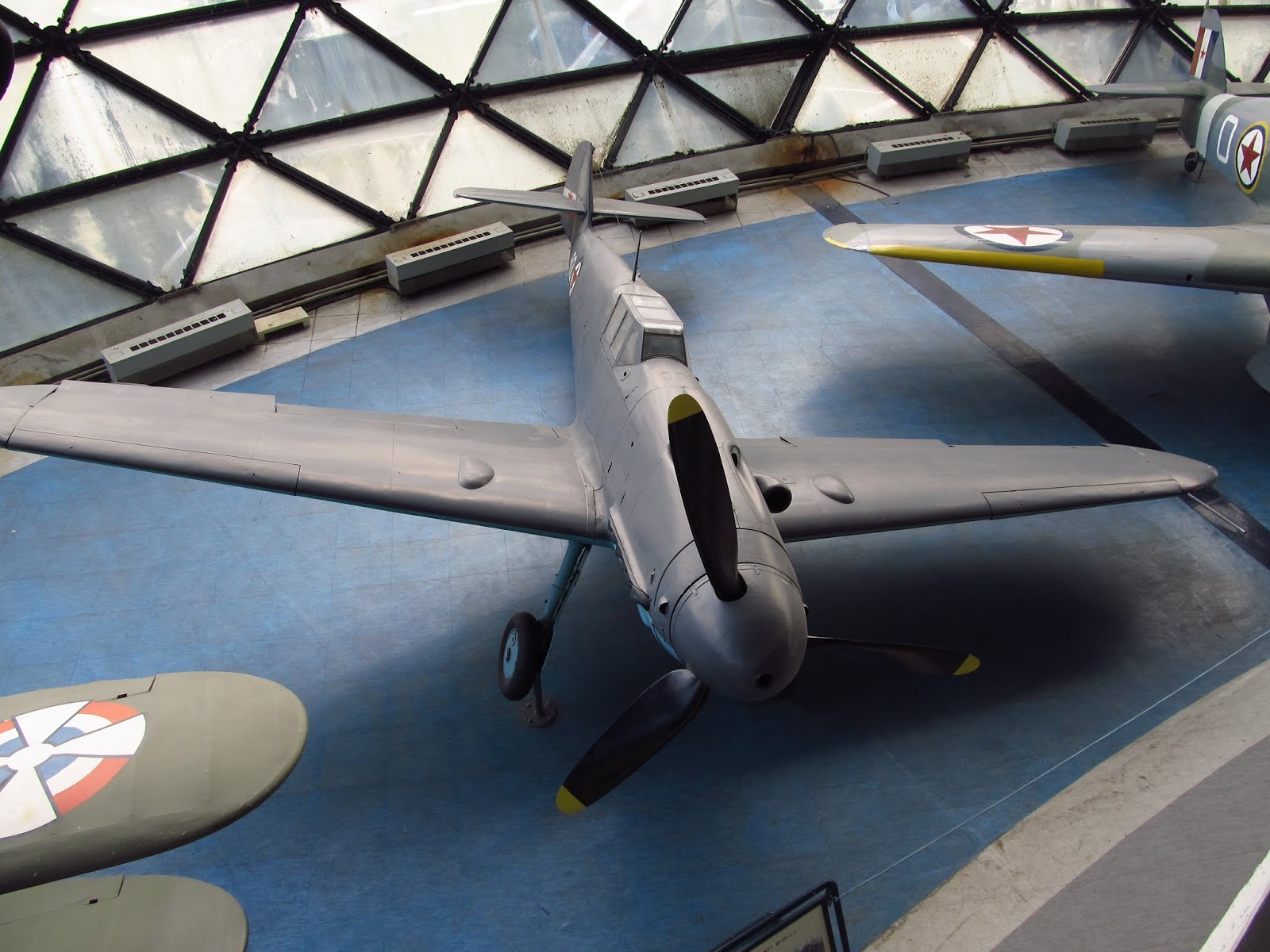
Messerschmitt Bf 109 G-2
Messerschmitt Bf 109 G-2 on display at the Muzej vazduhoplovstva Beograd at Beograd's Nikola Tesla International Airport in Beograd (Belgrade) Serbia.
"The Air Force of the Kingdom of Yugoslavia purchased in Germany, from August 1939 to the late 1940 about 80 planes Messerschmitt Me-109 E-3, which, in the composition of the elite 6th Fighter Regiment, were used during the April War 1941, participating in defense of the Capitol, Beograd.
Except 10 Messerschmitts, captured during the 1941-1945 war, on the base of the agreement with Bulgarians, contract signed on 1st August 1947, the next year, in exchange for metal parts of Ilushin IL-2, manufactured at aircraft factory "Ikarus”, from Bulgaria Yugoslav Air Force got 59 Messerschmitts Me-109, variant G and K, followed by more, totaling up to approximately 120 planes, of which 6 were of G-2 variant, 32 of G-6s, one two-seat G-8 trainer, 9 G-10s, ad 4 of G/-14 variant. Of those, 5 were wiped off, and were taken as a spare parts, 3 single seaters were in Yugoslavia converted into two seat trainers, while on one G-10 was mounted reconnaissance photo camera K-24. Due to lack of spare parts, all Messerschmitts were withdrawn from service in 1954.
G-2 variant appeared in May 1942, but this particular example, (Yugoslav Air Force serial 9663, c/n 741702), which came from Bulgaria, undergone a lot of German, Bulgarian and Yugoslav technical and practical changes and modifications. This example was wiped of service on 22nd September 1952, and delivered to the Air Museum. It is the one of only two "survived” Me 109 G-2s in the world."
Ilyshin Il-2m3 Shturmovik
Ilyshin Il-2m3 Shturmovik on display at the Muzej vazduhoplovstva Beograd at Beograd's Nikola Tesla International Airport in Beograd (Belgrade) Serbia.
Spitfire
Spitfire on display at the Muzej vazduhoplovstva Beograd at Beograd's Nikola Tesla International Airport in Beograd (Belgrade) Serbia.
"Spitfire Mk Vc, (the YAF serial 9489, c/n 17545) was built early 1943e, and it is the only in the world preserved Mk V variant plane with tropical air inlet with dust filter. By the end of their service, Spitfire were utilized as reconnaissance planes, with a vertical recording aerial camera built in on the left side, behind pilot’s seat. After being removed from an inventory this aircraft was allotted to the Military Museum, was exposed on exterior display, and 1961 handed over to the Air Museum."
Hurricane
Hurricane on display at the Muzej vazduhoplovstva Beograd at Beograd's Nikola Tesla International Airport in Beograd (Belgrade) Serbia.
"The Military Aeronautics of the Kingdom of Yugoslavia, (the VV), firstly, between December 1938 and February 1940, purchased in Great Britain 24 planes Hawker Hurricane Mk I, and in mean time Yugoslavia started building under ransomed license series of Mk I variant aircraft, manufacture entrusted to the indigenous aircraft factories "Zmaj”, (of ordered 60, until the beginning of war 1941, delivered 24), and ,”Rogožarski”, (of ordered 40 in April in factory’s plants, on production line, 24 uncompleted), at a common price of 2.038.000 dinars, a piece. In the beginning of March 1941 took off unique Yugoslav modification of Hurricane, designated LTV 1, (Lovac Vazduhoplovno Tehnički – the Aeronautical Technical Fighter, according the name of the technical section of the VV Command, responsible for the Hurricane modification). Instead of Rolls-Royce Merlin the Hurricane LVT 1 had a German Daimler Benz DB 601 engine, (a standard power plant of the Messerschmitt Bf 109E), significantly improving plane’s characteristics. On the eve of April War 1941, in the VVKJ units, in composition of the 2nd and 4th Fighter Regiments, were 35 operative Hawker Hurricanes
Exhibited aircraft by the end of the W.W.II was in composition of the BAF No.351Y Squadron, formed on 1st July 1944at Benina airfield in North Africa, and introducing of Hurricane Mk IVRP planes to unit started on 11th September 1944. After completing combat training (including firing and rocket launching), the unit moved to Italy, to the Cane airfield, off which took off on the first combat task on 14th October 1944, and, moving later to airfields on the island Vis and at Zadar (Prkos and Škabrnje), continued supporting closing operations of liberation the country, performing 971 combat flights. After the W.W.II Hurricane were utilized in the Yugoslav Air Force until 18th Augusta 1952, when were withdrawn from operative service.
The plane in the Air Museum’s collection, (c/n 20925), was built 1943. In Yugoslav Air Force got serial 9539, and after withdrawal from service was allotted to the Military Museum, and in 1961 handed over to the Aeronautical Museum."
Subscribe to:
Posts (Atom)